Social icons

RICE AGAIN

Sunday, February 7, 2021


I toggle between Francis Lam and Sam Sifton for cooking inspiration, and this week’s cultural attributions to their story-recipes where particularly lovely: it’s about Tet. Tet is the Lunar New Year celebrated in Vietnam, and it’s fast approaching (Feb. 12), and this means food preparation— and prolific and abundant and colorful and shiny they should be, custom dictates. I was impressed on the pickling emphasis using allium vegetables like pearl shallots and the rhizomes of green onions (very decorative condiments); and wow to their braised-once-grilled dishes achieving a “caramel coconut sauce” (the technique is beautiful). I imagine the family kitchen in anticipation of the event to be headstrong, generous, parochially communal busy (and proudly this is a very typical dynamic in SE Asian cultures where major events are times home cooks and traditional banquets take center stage). I am an inveterate eater of anything smothered over rice, say a thick but soluble gravy like the Japanese curry robust with carrots and smoked peppers. But give/cook me that coconut caramel sauce topped with pickled shallots and maybe some crisp leaves of scallions sprinkled on top— I’m in heaven for that rice again.       

(Flashback: Visiting Hue, Vietnam, circa 2009, resting in a covered wooden bridge/sleeping station with painted flowers motif and dragon carvings around the eaves stretching over a rice field, I solemnly take all my “food” voyages to heart. And poetry is like a small harvest I thank the world for.) 

Silk squash, a.k.a sponge gourd, braised in broiled tomatoes, and through reduction finishing it off with a fresh-cut sprig of oregano (from a coworker) to perfume my red-green sauce, and soon will be ready for ladling over you know what. I have moringa flowers, yes, and they will smile on top of my bowl. Lam had a recipe for Sichuan pepper sauce with garlic and ginger, maple syrup and lime juice, I’m on a menu roll for the next couple of days, truly from inspiration to food on the table. Thanks to my splendid guides.  

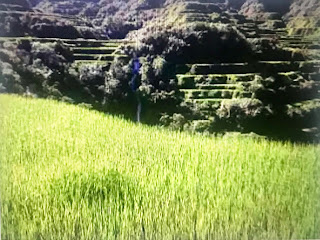
(Another flashback: I found a few vintage photos this morning of my field work as grad student at the Ifugao Rice Terraces, Philippines, around the same time I visited Hue. I will transcribe for you a hand-written caption in my journal signifying the phenomenal event any ethnographer researcher would boast. In the related literature segment of my thesis, I remember the theorem “non-locality consciousness” adopted by Quantum Holography science arguing that perception evolving from the cosmic process is reciprocal to a reality that was once a sublime. Indigenous Knowledge… the work of poetry… what I saw there rising towards the sky… was real.)   

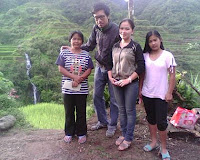
From my journal: I really wondered about the rice terraces the wondrous Ifugao had built – of their awareness of its stupendous natural beauty. I had also lived – in Hungduan (inset)– at this most amazing mountain summit of cultivated rice fields and waterfalls. No electricity has touched this place though it’s the 21st century already, but my host, an Ifugao native and winemaker (rice wine), Mary- her “English” name, had an even dignity in the hardscrabble, duty-bound expression on her face, unswept by the forest and rice culture oasis where she lives, near the sky. And why is that? I honestly didn’t ask her, though I should’ve when appropriately recoverable from our conversations. During my time with her, she never once marveled about the beauty of her environment as much as it had imbued me and my research. Instead, in her mythic eyes conjured the work to be done in the "high fields.”

A Measure of Benevolent Neglect

Sunday, January 31, 2021


Bunna Café, Bushwick, Brooklyn, c.a. 2017, photo by I.G.

The title of this post is directly borrowed from a recent food article in The Times by Dorie Greenspan writing about (and the recipe for) a cake salé. Her prose-wording is beautiful and personal it evokes a home kitchen that’s lived in by a bon vivant cook loving the artisanal process and loving the poetic at the same punch. She said that while mixing the dry ingredients into the wet batter to “turn a blind eye to thoroughness,” so in the kneading and molding of the cake mixture when transferred to a lined (or buttered) loaf pan will emanate on its own the “benevolent neglect” — and rise for you. In the least, that’s my understanding on the cross-section between baking and writing, and seeing awesome food-making how I “read” it. Greenspan is an American living in Paris. Vicariously reading, I am reminiscing my good old market runs and cooking in this artistic city.

But New York, as it was, had always been my kind of Paris where I could be a flâneur as much as a passionately-charge twin soul when it comes to cooking for your lifestyle. Bushwick was the emerging “beat generation” neighborhood in Brooklyn when I first moved to the city a decade ago, and it was an industrial den of retrofitted factory buildings turned artist lofts/galleries and bodegas becoming splendid chef-owner restaurants and food bars (Roberta’s, Shinobi and Bunna Café come to mind). Just like the 11th district in Paris, Bushwick is a hipster enclave with a food scene vibe that’s downright supernatural. There is a line in Puccini’s opera “La Bohème” that begs the question “What does a poet do?” [in this context], and the answer is: “He lives!” So many aspiring chefs at that time would live to cook and learn at any of these gastronomy havens, and I was fortunate to have briefly trained in one.  (I said I would work for free one summer, like the notion of a vagabond gourmet to write for food.)

Chef Sean, of Shinobi, still an acquaintance, taught me a lasting principle of the inviability of food without its tactile relationship to his creator. Let it go, he said, and let it live on the plate. You maximize the diner's experience by cooking the food yourself, from beginning to end,  your one server will take your artful ramen to the communal table, you nod for the triumph that’s before you as a sign of respect, and know its creator is still working away in his open kitchen yet could never take you for granted. And that’s the measure of benevolent neglect.                

“FOODNOTE”

Sunday, January 24, 2021


On NPR Sunday radio a feature called Moth had an interesting show topic: loops — a recycling of archival music threading the end back to the beginning of its instrumentation, and the track repeats ad infinitum. The “artist-on-record” remastering the banal had a very interesting use of this loop-technique to interpret the very conditions that happens in natural life: that its redundancy through analog analysis is uniquely quantum, linking the recreated to its original creation, and in his own words liking it to “inducing a bubble at the breadth-pace with the expansion of the universe” that is configured impermanently in its confines, yet invisible in its sameness.
  
Another avant-garde thinker, Dr. Andreas Weber, author of The Poetics of Ecology, theorized that the known beauty of our planetary world is a characteristic of an evolutionary gene that is responsible for the rhapsodic manifestation of its own makeup, satisfying life as an elemental process, crystallizing the firmament bluer than blue and gardening our abundant biodiversity with intelligent design. Weber believes that the poetics theorem is a fractal code already present at the beginning of time, and that its surreptitious job was to randomize and then reorder the cosmic existence. Photosynthesis is a blooming, and atmospheric conditions encompass and then circle a full earth.      

Sun Ra is a jazzist with a metaphysical voice embodied: “I am an Instrument.” https://youtu.be/1zib3JLRLdY

The eve of my departure from New York  City, I attended a Thelonious Monk repertoire concert at the Juilliard School. The tempestuous ballad Ruby, My Dear, (a Coltrane arrangement) re-broke my heart. The “poetry” was about the fear of the unfamiliar with feedback riffs around a love what would never die. I texted my musician and kindred friend in Berlin after the show and sent him an attachment of the playbill highlighting this wrenching tune. Waiting for the 1 train underground on 65th and Amsterdam, I got a ping back. It’s a quote from Carl Jung: “[It] symbolizes human life and development and the inner process of becoming conscious. Once could say that it symbolizes in the psyche that something which grows and develops undisturbed within us, irrespective of what the ego does; it is the urge toward individuation which unfolds and continues, independent of our consciousness.” (And Miro’s painting, the photo inset).  

The Cuisine of Mayon

Sunday, January 17, 2021

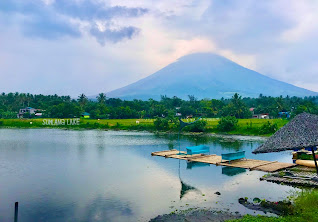
A staple ingredient in this region of central Philippines is the spectacular plant food from the tree of moringa. A global phenomenon, especially among fitness/longevity/wellness seekers, this ultra-nutritious greens (as fortuitous an addition to soups, particularly) has a hidden recipe beneath this "smoking cauldron." (Mayon is an active volcano, and a national landmark for its perfectly symmetrical beauty; it is also where my secret sharer hails from, she taking a picture of this view from her recent visit, and she telling all her awesome eats.) 

It is called the mung beans mulligatawny in coconut milk and moringa.    

Here's what you need to prepare for a simple but beautiful vegan offering: 
  • cloves of garlic finely minced (1 tsp full)
  • a medium sweet onion nicely diced
  • pinches of coriander, nutmeg, ginger powders, respectively
  • split mung beans (half a cup)  
  • pure coconut water (2 cups)
  • coconut milk (1 cup)
  • chayote squash (a small one is enough, cut on a bias, like an avocado on salad)
  • chili flakes (a pinch), salt and pepper to taste/to balance
  • some leaves of the chili pepper plant (for a "basil" effect; use basil if you can't find these leaves)
  • and, naturally, the moringa leaves
In this order, gently sauté the mung beans in olive oil à la arborio rice (as if making risotto) until the onions are translucent and perfumed heady by the spices. Then add the juices, letting it boil to simmering, covered, achieving breaking-tenderness texture to the beans (importantly: halfway in the simmering of your mulligatawny, you must add the chayote squash to cook through with the soup, to lend its deeper minerality in the broth - not for thickness, but for wellness). When done before shutting out the heat, add chili flakes and S&P, fold in, then drop the leaves. Taste for tonic richness and soothing comfort, warm and floral to the palate, and perfect to the waiting belly, for health and strength. 

Don't forget the edible bouquet. Serve soup in a dinner bowl garnished with the flowers of, yes, the moringa tree herself - they are very similar in form as the lilacs, except their color is bridal white.

Calamansi-soaked Lady Fingers Brûlée

Sunday, January 10, 2021


This is a layered dessert bottom-to-top a cross-section with cinnamon-macadamia granola, broiled plantains and sweet white bread soaked in coconut-ginger pudding milk. The idea of making it was fun, not to mention the process — the goal was commitment to the ingredients and assembling them to the perfect temperature and texture hierarchy. The tiny calamansis were a delight to juice through a sieve more than many times to generate enough volume, and taming the acid, I added cookie sugar (reputedly the calamansi is the tartiest of all citrus fruits, for sure at the opposite taste spectrum to the mild Meyer lemons). Toasting the granola and the bread with a dollop of butter will definitely deepen the flavor of the brûlée, absent a kitchen torch, thus the caramelization proof of this powerhouse sweet is inside the bowl. You might wonder why plantains in the mix? Well, I was starving for a “big breakfast,” and the banana-substance will do the job (think of an açaí bowl turning it into baked pudding gone further elevating it to a delicately delectable leche flan— that was kind of what I was experimenting/curious for this beautiful Sunday morning). 

It’s an Ode to Hunger.            

PS. Books, books, books, I’ll have those too. Their dynamic is to necessitate and nourish the mind-body, to eat is to think. I was at the off-the-beaten-path bookstore in Puunene yesterday weaving through the classics in search of Kipling. But instead, irresistibly, found these keepers: The Little Prince, St. Teresa of Avila, The Notebooks of Malte Laurids Bridgge and The Picture of Dorian Gray. I taught The Little Prince to my poetry club years ago and on break time would make French toast with the kids (our donated classroom inside a church in Jeonju was equipped with a kitchen, hence cooking was also part of my repertoire as teacher, and my students learned through osmosis my passion for food). I reread the children’s classic yesterday, and “I” was more than filled to the brim. How about… let me stop there and leave you with these lines from the book... I think they will more than tell you what’s on my plate…  

I ask [you] to forgive me for dedicating this 
[post] to a grown-up. I have a serious excuse: 
this grown-up is the best friend I have in the 
world. I have another excuse: this grown-up
can understand everything, even books for children.
I have a third excuse: he lives in [a valley]
where he is hungry and cold. He needs to be
comforted. I didn’t know how to reach him, 
where to find him… It’s so mysterious, the land
of tears. [But] one sees clearly only with the heart.
Anything essential is invisible to the eyes. 
I’d walk very slowly to a water fountain […] 
The stars are beautiful because of a flower 
you don’t see… What makes the desert beautiful
is that it hides a well somewhere…What I’m looking
at is only a shell. What’s most important is invisible…

— Antione De Saint-Exupéry  


Powered by Blogger.