Home food. Travel food. Foodnote. by Gary Estanislao
"A dish belongs in a meal, and the cook has to plan the meal so that what goes with what makes gastronomic sense." (the Ms. Julia Child)
Gigandes beans long marinated in vinaigrette (and already cooked through tender; from Whole Foods) plus shaved raw brussels sprouts are the two main ingredients of the dish to make this Sunday (and thanks to another cook who'd mailed me some of her fantastic homemade vegan and gluten-free table crackers using sunflower and flax seeds) with this to enhance the ensemble food I was already thinking about makes total sense together and deliberately - a harmony of flavors given the base stock I have of tomato-broccoli (overcooked and liquefied and pressed down with a masher to tidbits chunks) - the key is thickness and smooth in texture of the soup that will be instantly rich (the beans will be mashed too in the process) leaving only the tendrils of the cabbage to delight you like strings.
I am a soup guy (I have written about it frequently here); there is something about the thermo-healing chest effect it does to my heart and health that's perfectly slurp-able hot straight from the edge of the bowl (oriental-style) that really makes me grateful to the universe I have this to eat (with my bisque, though, I will have it a little more formal with a silver spoon), and savor slow and dipping the crackers genteel. (This is a collaborative meal, and the invite to my table is vicarious in manner.)
My view of gastronomy is akin to the quantum concept of super-partner particles of matter paired up to create vibrational resonance (indulge me here, folks, a stretch, this reference is attributable to the current book I'm reading - Brian Greene's The Elegant Universe - I am steeped in its descriptive science, it helps the way I think by complement, as is with Ms. Child's. In other words, if a devout cook is to understand (or already had got it through his long practitionership in culinary) why things are the way they are, or why ingredients taste the way there are - in the most fundamental level - then his food will be beautiful and balanced, and presciently verified, as poetry is also his trade, so he will unify his food story and please the palette.
![]() |
| Photo by T.M., from her kitchen in CA. |
"Some of the best cooking is done with virtually no tools" (Irma S. Rombauer, from the The Joy of Cooking). Gardening to grow your own food is fundamental to that artisanal kitchen. I remember this reader of mine sharing a story about her vegetable patch in the backyard prolific with sweet potato leaf-vines and harvesting them as salad greens to blanch lightly and juice with lime or lemon only, a little salt, and bowl it up with steaming rice laced with sesame oil and chili flakes and spoon away the uncontrollable umami - what a rustic take on a beautiful, simple meal connected intimately to your home, straight to your heart's health! There are other nutritious greens from roots vegetables you can use with this quick blanching technique other than all varieties of potatoes, so please eat beets leaves, parsnips, yuccas, yams. And don't forget the rice (bowl) presentation. Eat the flowers, too, if they have them after you decorate your plate. Above all love what you do in your kitchen while cooking - because your garden just outside will be happy. I can see it.
I daringly proposed to my cousins to have another go at my vegan food and spend their last Sunday dinner on the island with me at home cooking for them how like my mom used to do (whom they had known so well back then) calling family over to come by and eat. So I texted this menu for their determination:
•Sorrel Leaves Farro Risotto
•Chayote Tendrils Salad with Mountain Apples and Chico Fruits
•Espresso Brownies with Berries-Orange Compote
And I closed with, How often do we get together like this, cousins? My mom would be really happy.
The sorrels are in season - a spring herb:vegetable on the tangy and acidic palette profile - that come back this time, it is a family of the spinach with a vibrant zest when eaten raw; it would be delicious in a creamy risotto while stewing, offsetting their bitterness spice for unctuous earthiness, and with buttered pine nuts in the mix would produce another level of tastefulness (think of collards and mealy grits combined - but Italianized).
So are the fruits. I love the concept of the plating color juxtaposition of ruby red (mountain apples) with chartreuse brown (chicos) over filigrees of steamed greens dressed in calamansi vinaigrette. The pairing of this salad with the rich risotto I think will be marvelous and be very al fresco dinning experience.
“It’s a champagne from a bottle of Mum, what I had for a lucky piece and wish me luck on it and that will do - best piece I ever had, and now it’s spirited away.”
(Ernest Hemingway)
The boys are fishing while the girls and yours truly, the de facto family cook, are in the kitchen prepping up for the three-course menu, plus whatever catch from the sea is brought home for the omnivore stomachs (I told my cousins to butcher and clean the fish there at site for direct steaming or grilling here, absent the gore). Of course, for once in a blue moon reunion, I will make exceptions in my kitchen’s strict plant-based ethos.
I will miss them dearly when they leave for the mainland midweek. But I will make the most of this “Last Sunday” dinner with them with how I do it best when it comes to love: cooking.
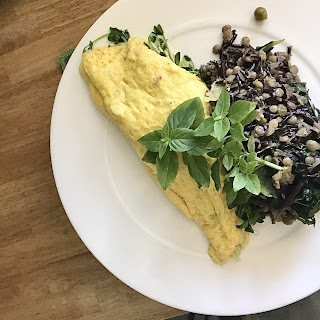
At Mana Foods a new vegan product is on the rise - and the reviews have gone wild from word to mouth, literally. It’s called “Just Eggs.” I put the “ready” beaten liquid mixture to the test this morning, and it did not disappoint. (Foodnote: I don’t really eat eggs in the conventional sense given my diet restriction, but French-style omelet is a classic food and something that I had loved before especially on a baguette, plain with butter and Dijon mustard, to carry out an obligatory breakfast meal.) But instead I had fresh pea tendrils in the fridge and wild black rice-lentils green tomato risotto cooked yesterday (with extra) and decided to put together a lovely brunch of just eggs and rice (in photo). Real eggs cook well in butter on a non-stick skillet over medium heat swirling the batter around while titling the pan and with a wooden spatula gathering at the center reserving the center raw to bake when three-folded (a culinary school technique every aspiring chef should master). Just Eggs surprisingly achieved the consistency of the technique without much regard to its authenticity - it just worked the way it should as the original - and I was pleased-shocked evenly. Now the taste. Before we go there you must know that the food technologists responsible for this nouveau product used mung bean as base protein sauce with other plant-based ingredients to naturally coagulate and emulsify the mixture to achieve the requisite coat. I remembered a former classmate of mine in grad school who eventually had taken a career path in biotech was really passionate about molecular food synthesizing in producing processed eats canned or frozen and how those foods can extend out their expiration and serve and help plenty without time or enough money to spend on kitchen prep time. High level and advanced food technology to the point of “cloning” like Just Eggs to cater to the vegan and gluten-free demographics (which by the way, according to market research is the fastest growing buyers of health and environment conscious food), is an amazing feat. But at what cost? Given the potential for large-scale production of these beyond egg alternatives responding to demand. But I won’t go that high road at this time (there is another journalistic platform for that sentiment) I want to return accordingly to my review of its taste. It’s a miracle that given a blind taste, whether the cook is really skilled or the product is really resilient, or both, nothing could be further from the truth. A perfect French omelet must have the texture of vulnerability and bouncy savory by fork-to-mouth at once with luscious delicacy sustaining an ephemeral buttermilk enhancement with bitterness from the greens extruding a poetic balance. What a Food Tech. genius! I wonder how my old classmate’s doing these days, at what level is he engineering food’s cutting edge, and what masterful synthesis he’s discovered at the DNA level of plant ingredients to stir away food production from intensive energy extraction at feedlots to sustainable earth practices of food eating while preserving open spaces and trees en masse to boot. I cooked an impromptu dinner once for this gentleman during one of our field (research) trips completing our thesis in indigenous knowledge and traditional agriculture. I had sense then, enjoying his meal and making critical comments, he had the culinary sensitivity-in-the-making of a Dr. Gourmet. I’m sure he will travel far and wide.
While making mashed kohlrabi simmering for now in silky almond milk in a sauce pot (later when tender and out of cooking heat will add German butter, salt and pepper, chives), and while picking out more foliage and tendrils for braising (see photo) I was thinking of another cook. She is a master vegan chocolate fudge baker and an old friend living in golden So. California with her husband and four rambunctious corkie-terriers. The quality of her work is consistent, and her measures are precisely what you’d expect to render the ingredients their devilishly good balance on each bite and melting in your mouth. When I visited family last weekend in L.A., I made sure that my carryon luggage would have enough space for the goodies she’d made sure I took back home, because I wanted nothing else to bring to Hawaii but her fudge and more. She is a trained classical calligraphy painter and her homemade chocolate boxes for me have exquisite liner notes inside naming each ingredient and their terroir origin for the cacao (it was Venezuelan fair trade), and everything is organic sourced and nothing sweetened (she said that the Philippine virgin coconut oil she uses has natural sweetness to it, and the pralines and dark cherries she adds at the center have them too, in nuts fruitful). It might be a surprise for you reader to reveal this, but in spite of my strict herbivore leafs and fruits diet, I have a “unsweet” tooth - but only one cook in the world will ever satisfy that craving. There is something about her fudge that the longer you keep them (in keep mine in the freezer; I consume one fudge nugget before bedtime, stretching out twenty four pieces for almost a month) the better they get as they old - they don’t turn into stone - instead sustaining a ganache-gelato-firm-but-velvety texture and the chocolate cacao like molten soufflé. I love it and have not tasted anything quite like it in expertise and deliciousness, not even in the famed maisons of Paris. Honestly it’s hard to translate “love” to result in cooking, but I think this feeling truly materializes in the effort of finding the best-sourced ingredients combined with a recipe of thoughtfulness to gift them to friends and in turn transliterating food into love-box of chocolates. There is something calligraphic in the swirls set on the skin of her chocolates like something “penned” by a technical hand yet dipped in a fountain “ink” of fudge. Writing/painting are artists acts of love. Yes, those too. Kohlrabis are bulbous root vegetables larger than beets and waxy red potatoes but blend their tastes together with hints of ginger and fennel. They are done in the milk, super tender, and now it’s time to butter them up and season, fold in and mash, and sprinkle herbs. I wish my good friend was here to join me for lunch. Although it’s just been a week, I already miss her. It’s still tough to be alone no matter how good you eat. That’s why I keep writing, writing, writing … to feel love.
“Time like a genie stands everywhere as though a shoreless reflection of the universe, at times becoming deception of thought, at times unthinkingly the awareness of beauty.” (Meeraji)
In most cultures, this call to table is an obligatory gathering of the family unit, and the home brigade responds to eat together with gusto. Lolo (grandfather) was the head announcer of the communal feast — and it was always a time when appetites were at their peak to charge the dining hall for the best seat (but there was always plenty of food to come around for everyone). As a youngster, eating had impressed upon me a sociological context as belonging to an intimate and rambunctious group who had actually loved me to my heart’s content, and cooking was designed in my household for exactly that purpose. And what I was proudest of was that my late mother was Lolo’s favorite family chef (over my other aunties) because she was exceptional on all counts running the kitchen and presenting the banquet magnificent. This inheritance is very clear to me now as I carry in my full heart the tradition embodying my grandfather’s invitation to eat and my mother’s cooking on par with hers from everyone in my closest circle know and delight about not to miss if I was at the kitchen. I did exactly that gathering today with friends=family at our reunion in Los Angeles to rally around a loved one indexing a health boost — and my clear purpose was to cook healing food for the soul with a company of laugher and good energy more potent than any prescribed medicine could give on the clock. My French lentil soup was a butternut squash and celery broth concoction sweet enough for the shaved Brussel sprouts and kale marry into with crystal simplicity elevated by chives herbs. My salad was a playful ensemble of edamames, pearl radishes, yellow cherries, dates and micro greens classical dressed with nothing more to wit than freshness. To awaken the palate in others is why I cook for the life of me — meaning: this is how I love you, as I was so loved as a child of food.
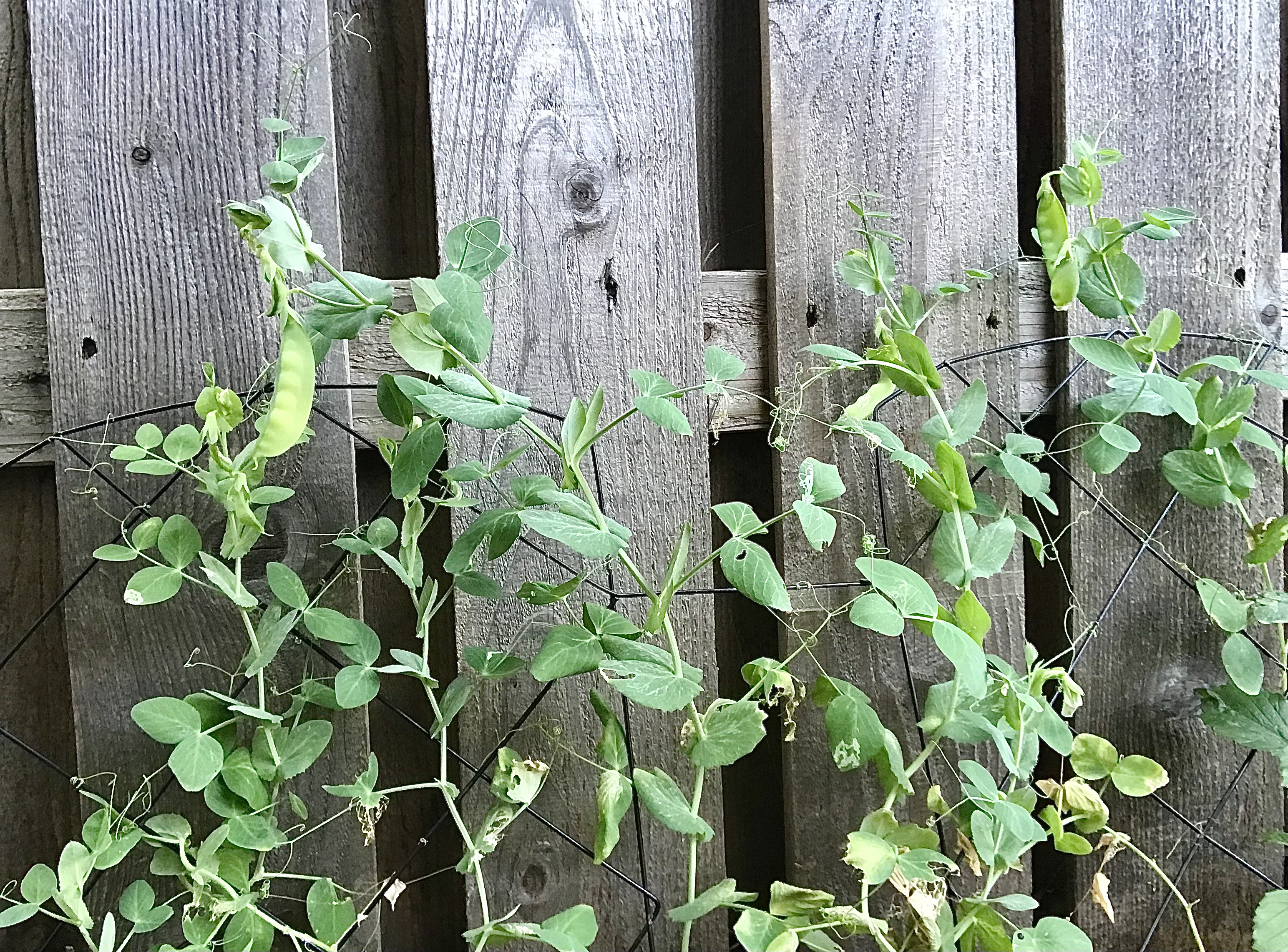
“Like a lounge lizard who reads Flaubert” cooking otherwise keeps me healthy and on my feet for the time it takes. Picking out vine leaves from a clump of fresh harvest bitter melon greens from the side garden that many to make little when braised, is a matter of kitchen devotion and survival. Frankly I can’t eat anything else at this point in my life except greens - and fruits and legumes are included in that designation since they start out green from the soil. Yes on a Sunday when I could otherwise read all day, food for my constitution’s requirement is a tall order that just had to be done - lest faint out or meet demise. Oscar Wilde said to the brazen everything is brass, but to the vegan, yours truly, everything is vegetables. But I couldn’t love anything more. I will always have an affair with the sofrito of carrots and tomatoes and diced stalks of Chinese cabbage to sweeten my bitter vines and juice out their chlorophyll iron to sauce and vitamin me. It takes a ton of eating greens to strengthen my body (think a panda in the bamboo forest nothing else on his agenda but ruminating those greens in its mouth, as cows do too and nothing else for them save grass and meadow) to live. My yard is my forest and meadow and I am their gentle “pollinator.” Pea vines grow there with the green beans, and mustard greens are friendly neighbors to the rainbow chards, dino kales are germinating, and the society of herbs planted are playmates to them greens and edible violets and shallot blues in the small scale garden ecosystem. I mostly rely on my farmer friends in the neck of my woods for “bulk” produce purchases to supplement my own meager harvest home, and combining these “bio-carbonless-sources” feel good to be part of a food-growing community which is essential to the future of life - all Life - including our green and blue planet to be more green. Rice, pasta, bread I eat no longer “evolved” to this point reckoning my true physiological nature as herbivore; I can’t break them down no matter how hard I try. I don’t mind my incarnate self now as from a bear or a bovine - they are gentle animals, you see, and cute with a bell. Greens are music down my throat and I’m clinging these words.
I was typing a poem entitled Typing V on my manual Smith-Corona when this recipe announced itself in my head, not necessarily disrupting creative flow, but perhaps extenuating it (the first verse in the poem had foraged Chinese violets pictured on the ground, and they were edible). Vinaigrette should be a staple condiment/sauce enhancer in your home ready to use, especially to dress your salad lunch or dinner, and it ages well blended in at once while fresh; though oil and vinegar separate and ferment alone, they will osmose your live herbs bottle-wide, like oak to bloom in wine (in my house vinaigrette I used flowers of shallots, marigolds I grow and wild micro-tomatoes from the nearby sea wetlands bog). Perhaps Patience Gray, one of my beloved literary food writer heroes, whispered this recipe in my head because the poem I was writing was unwittingly about her, too, with Gary Snyder, a modern day Basho, in New Mexico. For sweetness, lacking sugar in my cupboard, I used the tea granule powders of cinnamon, cardamom, clove and chicory root from the bag branded Yogi, a soothing caramel bedtime herbal supplement. It should work. And for a lineage of heat, red pepper flakes and their seeds in the bottle. In Buenos Aires years ago when I had studied with Chef Manuel Posse, my classmates from Germany, France and Japan organized a parilla (barbecue camp) and I was in charge of, you guessed it, the salad to go well with all the butchered meat to grill, and while I was at it made also vegetables of halved onions and green zucchini skewers. The dressing I did used local wine vinegar from Mendoza, the oil a mix of grape seed and olive, copiously together, and key to elevate the emulsion glacé is sugar and salt in perfect balance, but in harmonious zest to the blood sausages drip in gif sage and short ribs rubbed down smoky of Spanish paprika and garlic chimichurri. Rolf was delighted with my dressing and said it reminded him of his grandmother’s recipe in Köln. I was watching an old Martha Stewart cooking episode last night, an event she hosted at her sprawling and elegant estate ranch in Bedford, MA (the grounds were so beautiful from a bird’s eye like the castle at Versailles) celebrating a silver anniversary of her Living magazine with her editorial and creative team and their spouses as guests, and she did all the cooking for her staff - the boss giving back to her loyal employees, through an All-American aristocratic banquet feast to the eyes. The long table outside her largest greenhouse was draped in taupe linen cloth and decorated with bouquets of mixed herbs and succulents, very Martha design, keen to detailed beauty, across the line. Her salad was princessly simple and aesthete: in fresh-cut radicchio leaf made into bowls, she put her chopped corn salad tomato verde greens dressed only in oil, rice vinegar and sugar. And the rest is history.
(Mark Bittman)
Q: How did you learn to cook?
A: It's acquired, first and foremost. Even if I had worked in professional kitchens in NYC and had studied with a few great chefs, local and international, training doesn't necessarily demonstrate the fitness and quality of cooking, it's more personal than that. I see cooking as you want to be in the kitchen to work hard, as did your mother or your grandfather had been to raise you with unforgettable foods.
Q: Can you give an example of a formative dish that shaped your enduring sensibilities?
A: Sure. But it's the archetypal memories of the entire process I remember more than just eating, your family molded in that responsibility and enjoyment you saw from a young age routinely tagging along to the marketplace and observing what they buy, how they pick it and engage with the producers, and how those ingredients come together beautifully and tasty on the table at the end of the day. Is that what passion is? I think so. And that's what I acquired "in my blood." Mom's curry stew fortunately had been replicated by my only elder sibling and I'm glad it wasn't me but her, because it could never be the same without a maternal touch that elevates its alchemy on the spoon to love. However, once on my birthday I tried making mom's blend of rice and egg noodles dish with snow peas, carrots and cabbage, and sis almost cried.
Q: What are indispensable tools for you in your home kitchen?
A: Other than a chef's knife and a wooden cutting board, I have an extra large, deep silver salad bowl to wash my vegetables in and dual purpose as the bowl where I mix my vinaigrette dressing on the bottom and toss those greens to soak, then serve. Rachel Khoo is a favorite chef and author I had followed years back, and she had lived in such a tiny apartment in Paris and had used her salad bowl for everything - baking, marinating, you name it, and can't live without it.
Q: What did you cook for lunch today?
A: A simple split mung bean soup with tomatoes and radish as binding elements. I will tell you a secret. The tomatoes and radish were my salad yesterday, and I had leftovers. I used them as flavoring ingredients (the salad was dressed overnight and fully soaked) and therefore as the mung was tendering in the pan and the salad was macerating evenly, I only needed salt, pepper and a little olive to achieve the desired taste. It was that easy, but full of intention to make grace.
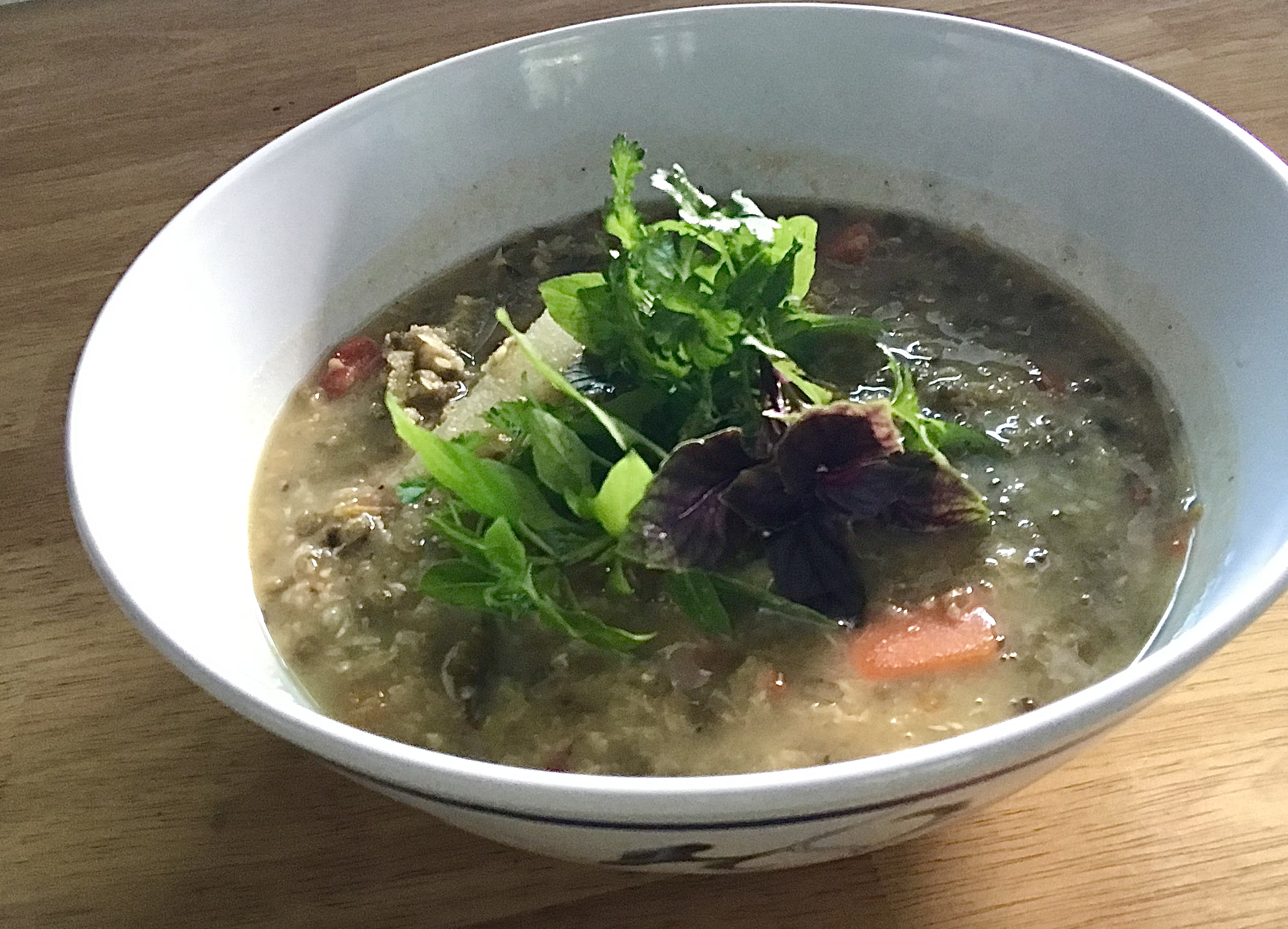
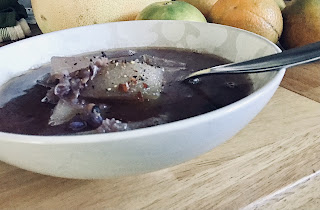
In one of those Instagram quotes I read in passing I loved what it said: “May we all continue to be blessed by the incredible biodiversity of wild things.” The post was from a forest forager on the island, and it featured tropical plum recipes made into syrup for tart glaze and other preserves and this workshop wedding cake-like centerpiece stunning in purple inlay frostings design of jelly ivies. I love creativity in food extending its capacity to awe, as creativity in color is food’s intrinsic quality. Foraging is an eye-skill in the challenging woods, and when they make it to your kitchen the wildness never dies in the hunter. Nature the greatest caretaker of wild food - that is biodiversity’s gifts of earth divine, a produce market stand without a price. This is sweet beans plum soup in the picture - an extraordinary take of the taste of wild still tasting “the olives in the oil, or the grape in the wine, or the dark chocolate in the cocoa pod.” This is the biodiversity of flavor composed here by the cook to capture the essential stew of purple in the plum. I owe to artists my lunch, to the yeasts of sourdough, to the meadows in clarified butter toast for its melt. I am on friendly terms with this post’s forager, I see her on the valley road at times and she smiles. Yet formal between us is our shared love for wild things cooked. Common also between us is a comrade I now remember whose wildness is a true form in his soul. The three of us would converge in her garden behind her home overlooking Iao stream after a swim in the forest pools still wet in shorts under the sun and talk about the benefits of wild food and hunting-gathering. Comrade believes in his heart to be direct descendant of the epoch when the first upright men roamed the wild earth for food sustenance and fire and place, without which the development of our complex minds today would’ve have evolved if not for the relationship begotten from pre-historical nature we learned from before our own. I miss him. I miss his brilliant mind. When I see the forager lady, on occasions I do, I see my old comrade in affectionate figures of memory, a genuine Montaño.
Dear Universe:
Bless these gifts from your bounty these lilacs of yams and anthuriums of tomato cherries.
Bless this your bread, we share as companion friends.
The pumpkin you sheltered under wondrous leaves on cold stars, thank you.
Your ocean crystals made salt, your mystic swamps grew shrubs of elderberry peppers, thank you.
And for the clay of your earth that formed this white plate.
Thank you for our home, our work, our plants, our music, the river stones shaped like whale art on the mantle, it is for luck.
At this table in situ accept our gratitude.
Bonne année, Universe.
Your provisions, this constancy, in our minds receiving food granted, just like that; yet it is not without humility we make time and remember and include you in our lives before you feed us.
You are in our midst.
Forever.
A dinner candle.
"They flicker and flit through branches and reeds like sunlight on a windy day. [This] perfect world." (Annie Proulx)
Giving, sharing, donating, volunteering, cooking… — these are all gestures of benevolence for someone. The fictional Sal Paradise (if you remember from my old post titled Soul Food) came to town and brought with him “gifts” under my Christmas tree. (The material present even if it’s just one, is infused with layers of thoughtfulness only from a “Santa” intimately familiar with who you are, and how food is your comforting element; and to suggest perfectly the ambience for a recipe I could do with his gift in, say, a dreary and cold rainy day like today, to make buttery grilled cheese sandwich on the panini maker gift! with a sweet card writing that I make a nice hot cup of chocolate drink with it for full experience of coziness — goes a long, long way to the cook at heart.) There’s probably a very generous reason why his name is Paradise.
I will be watching Love Actually and couch out this awful rainy Sunday with hot cocoa pressed between my hands, laptop on. It’s a holiday must-see movie tradition that’s dear to me, it’s very romantic and forgiving, even if on Christmastime “you tell the truth.” One scene that’s a high point in the film is a caroler secretly in disguise addressing his longtime crush, who happens to be his best friend’s wife, by showing placards with notes of his feelings for her finally revealed on this “Holy Night.” He knew it won’t amount to anything but did the impossible “giving” anyway, and gave his full heart to her, revealing his feelings, for nothing in return. He walked away from the house onto the street carrying the boom box still playing the carols under one arm and under the other the big handwritten notes that told all, and to his surprise she followed him on the street running and he turned around — and got a deep kiss of thanks from his secret love.
Joni Mitchell’s song From Both Sides Now was on the record player when the impeccable Emma Thompson, one of the main English actors in the film, emoted the pain she felt learning of her husband’s extramarital affair at work on Christmas Eve, and worse on their children’s Nativity play at the elementary school they were, as family, to attend, showed her resiliency instead to overcome the betrayal. Wiping her tears away and not showing her family, gathered everyone to the car so they won’t be late for the show, and the kids were excited to evidently, and then she looked at her husband in the eye to mean without words, I know. But not without out love.
Santa knew I love this film, its message of unconditional giving, of sacrifice for truth and for togetherness. Santa knew I would need nourishment by way of feeding my heart all worked up during the unfolding of story in this film of ordinary people experiencing extraordinary acts of giving and forgiving. And he’s always right.
Social icons