Social icons

Purple Hang Town Fry

Sunday, October 11, 2020


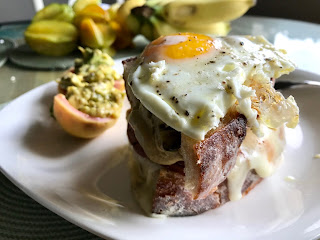
The Heathman Hotel Restaurant in downtown Portland, Ore. has the best hang town fry breakfast in the city. The origin of this dish is Northern Cal., and it consists of oysters, eggs, onions and potatoes. It is presentably a scramble that is crisped on the outside like hash browns/frittata, yet its inside melts in the mouth because of the oyster’s slurp-slide texture. I used to work at The Heathman back when I was a grad student in writing at the nearby university (PSU). Sunday brunch folks loved ordering this dish with plain green salad as a side, and a requisite mimosa flute, and I remember sending the fry out table after table— and they killed it. Particular to the dish is its technique of mashing-chopping-folding up of ingredients on the griddle using two steel turner spatulas on either hand, and binding them together with one adjoined flip. It is quite a show, I think. (The fry, incidentally, is also a common street food in Thailand using pretty much the same inputs except the deletion of potatoes for strips of banana flowers, then doused with a sweet spicy sauce; the price is very, very cheap but the taste is very, very good.) The American version is just as delicious, and so I decided to make something similar for my Sunday. 

The Hawaiian sweet potato is color purple inside. I had baby Swiss chards and some fresh herbs (thyme, basil, oregano), brown eggs and garlic pita bread. (I precooked the sweet potato steamed tender and diced up chunks with skin-on, with a little salt and pepper, the day before.) Putting together my fry is pretty straightforward and fast: butter and olive oil in a hot pan, dropping minced stems of the chards and herbs until they sizzle and fragrant, add the sweet potatoes, stir nicely, then flourish the ribboned leaves of the chards on top for offset binding, mix, no special flipping technique necessary, cooked them quick together and fluently (five minutes tops). Toast pita and cut as you wish mindful of plate design and the ergonomic of eating (do you want to mop up the emulsion juice on the bottom of the plate, or make a bruschetta to pick the hash to the bread and finger food it?) Up to you, follow your appetite rituals. Lastly, don’t forget your glistening egg with a golden yolk; it must ooze and must be seasoned and flecked with red chili pepper flakes. Serve a l a Heathman-style (the hotel is a four-star boutique inn and the interior of the restaurant is a formal French bistro ambience). And then my fry is up.

As a long-time cook (and have been joyfully passionate about it), I use classic recipes, smart techniques and photogenic (often wistful) memories as a way to bring food on my table and delight on my palate. I’ve learned so much in Portland as a cook and urban gardener. We had happy (food) times there, and many friends to celebrate.        


LIME BELLINI

Sunday, October 4, 2020

For someone like me
The simple things
Like having toast or
Going to church are
Kept in one place. 

                                                            - John Ashbery


This is a virgin Sunday brunch cocktail. However, the fresh-squeezed lime juice is sharp enough to give the drink the tannin astringency mixed with plain sparkling water as if it were a champagne. The "cherry on top" was diluted to the juice to lend itself a sweetness aftertaste - all fresh-squeezed local fruits from Maui nui: guava, star fruit and tangerines, sifted through. For the main dish: braised carrots and cherry tomatoes with ravioli. In the poem Mr. Ashbery brings it home by saying the substance of this food combined is like wine and cheese. Not in the picture is a simple salad plate of sliced plum tomatoes and parsley - because, alas, the bread is already dripping with butter. I love the Moroccan tagine quality of the carrot-pasta braise chased with the refreshing-cleansing function of the bellini. (Foodnote: If you happen to be in New York City at some point for travel/business, you should check out Cafe Mogador in the E. Village. The restaurant is hip and the N. African/Mediterranean fare is heaven. I always get the fried okra and shallots tagine in dates, olives and chiles sauce. And the hummus-baba ganoush plate is divine and the warm pita is manna. An Oregon pinot noir is essential; ask your lovely server for a rec. The Morocs invented the tagine technique of cooking dried fruits and meat in a claypot over wood fire until all are braised tender and incorporated to the sublimity of the ingredients and spices, for a minimum three hours depending on the meat.) My rav is an homage to Mogador, my favorite restaurant, I have missed so much - and to the city itself, where I left my heart.     

CROQUE MADAME

Sunday, September 27, 2020

    The sourdough bread of this tall ham and cheese sandwich, made complicated because it's French, is two-sided: the jalapeño cheddar side, and the plain side. But this is homemade. In a 12-inch frying pan on medium heat I melted a good amount of butter sprinkled with nutmeg and soaked in the bread, turning them over when slightly browned. Shut stove and remove from heat. Meanwhile, set your toaster oven to broil and prep the cured ham by lathering it with olive oil and fresh-cracked black pepper, then folding over once sealing in the rub. Set aside. Harvest the soaked plain-sided bread from the pan, plate it, then add overlapping thick layers of pepper jack cheese and muenster - and stick it in the toaster to melt (roughly four minutes). The jalapeño side will be the spreader of the essential dijon mustard flavor to the whole sandwich, so dollop on a spoonful to it beautifully, while waiting for its other half. Time to cook the egg. Pretty simple and here's my technique to achieve a perfect molten yolk, firm around the contours but the center is emulsified: cover the pan with a clear-glass lid (perhaps from your stock pot) and swirl the oil around cooking the whites evenly, leaving the yolk red for the steam to cook it desirably (on medium-high heat, total time for this style should be under three minutes, making sure the oil is very hot before placing the egg). Now assemble the Croque, melted cheese-side up smothering the ham on the bottom - and crown the Madame with your perfect oeuf frit (fried egg). The height of this sandwich is pretty big; I had purposely sliced the bread thick and "pastramid" the ham to match the fondue viscosity of the muenster jack. More fresh-cracked pepper and olive oil blot as final touch, and you're good to go. Eating might be a challenge so prepare yourself a steak knife and hold down the sandwich with your other hand. A vinegary malt coleslaw would be a great pair for offsetting flavor profiles that overcomes the mouthful of béchamel ham on toasted country bread that's butter-rich and slightly spicy from peppercorns. The salad will spike your food to wonders because the oeuf frit was marquee to it all.             


"Be realistic, demand the impossible." - Joseph Remnant 
(French photographer and social justice activist)

(Bread, by M. Toku)

CHIVES FLOWERS AND SEAWEED GRAPES

Sunday, September 20, 2020


 Once upon a time in childhood, chives flowers and seaweed grapes were family salad meals— and to this day I would never forget their beauty on the plate and their crisp-sweet-brine-citrus taste. Grandpa always had them prepared on Sundays at the rest house in Laguna, among other delicious food and desserts, but these floral vegetables were my all-time favorite. I suppose I was, by nature, an aesthetically and culinarily curious lad, but Pa made cooking and eating really interesting for me. And these informative years began by tagging along with him at the local farmers market and fruit stands along the provincial highway. Basket in hand walking up to his go-to venders, he would ask enthusiastically about what’s fresh and what’s good, exchange recipes with them and how-to, and then gather up his usual staples for salad; they’re already prepared, they knew I was watching with a shy smile behind Pa, they would say hi, and off we go. (Foodnote: chives flowers are a family of green onions/scallions plants but their root-to-stem structure is firmer and the tips have bulb nodes signifying imminent blooming.) However, in my family they’re “eaten in the bud.” Pa prepared it this way:  a chives bunch was cut in equal thirds and steamed piping hot for a few minutes— and then immediately served dim sum-style on small plates topped with oyster sauce. The allium nuance and unctuous salt was what I loved the most about it, with white rice. For balance this was how I was taught to enjoy it best: with a side of chilled seaweed grapes salad with chopped tomatoes and diced green mangoes tossed in coconut vinegar, a little salt and pepper. (Foodnote: seaweed grapes or sea grapes or “green caviar,” latok/lato is the indigenous name, is a very common seaweed/kelp grass in the Philippine Islands where I grew up.) Think of a vineyard growing chardonnay grape cultivars, and on the vine bunches form tiny green berries shaped like tiny Christmas trees— that’s how lato looks. On the appetite level, it’s awesome because the flavor is hidden in the sea berries that would eventually burst in your mouth. Chives flowers with rice and then latok salad is a panoply experience of inherited good eating and how that play in plants combined could fullest deliciousness be achieved.
 
An older photographer friend of mine visiting me in New York a few years back (by the way he is also a gourmand and a food critic), over dinner at my apartment told me that the best way to eat well and fulfillingly was the substance of nostalgia. Pa and the farmers were always happy to see each other every Sunday at their stands. Pa had gathered three generations of his family every Sunday at the rest house and wonderful food was served all day long al fresco. And what I remember most was after lunch, he’d take a strong shot of drip espresso in the kitchen and then head to the lanai for a nap on a bamboo bench… looking always happy, and at peace.   

THE CLUB

Sunday, September 13, 2020


This classic sandwich is a remake fresh with ripe avocado chunks, pitted green olive halves, and torn basil leaves. And for seasoning: ground black pepper, lime juice and olive oil to taste, very simple, and no salt was added since the briny flavor from the Italian castelvetranos will do justice to the spread. It was a marvelous filling on lightly toasted Japanese milk bread, cut diner-style (as photo shows), and instead of side fries on the plate, this cook substituted roasted peanuts to offer a health-intentioned option. I had never thought of olives to combine with avocado before— so this surprise “guacamole” was a revelation, and I loved its toothsome savor. Try it! (You don’t have to triple the bread, two would suffice. Slicing to club triangles, the sandwich will make up for the presentation de rigueur, just nicely arrange the pieces as a lump sum of all their sides face up, and angled. This is, without exaggeration, "a midsummer night’s" ambrosia, and you will delight in its delicious spell (like in the play). Imagination subjectively helps. The roasted peanuts with chili flakes came through as a great combo for the club. In the play think of acorn pine nuts, forest fruits and pan de sal banquets for pucks. Don't forget the tea-wine to enrich the (your) spirit, and to chase out your dreams.
...

On the 13th of October, 2007, something very special happened inside a church in Jeonju, S. Korea: a poetry club was born. Next month exactly on this day this year, THE CLUB will be celebrating its 13th anniversary. The beauty of this coincidence is in the semantics that, for this fraternity, poetry lives on to the calendar. Imagine by reminisce an old church welcoming a group of young romantics who were given a private mantle, a study, to search through words beyond the confines of faith— to be pilgrims for “active knowledge” and to “sail beyond the sunset”; the hunger of their souls was their wild grace. Poetry is hard to break. The bond is predetermined. And the poets of this class knew their fate. The master fed them for life.        

Powered by Blogger.